
This week, I began developing the prototype for my project, which involves integrating a sensor into a circuit. After researching several options, I decided to use a DHT11 sensor, which measures both temperature and humidity. My goal is to create a system that sounds an alert via a piezo buzzer when either the temperature or humidity exceeds a specified threshold. The real-time readings will be displayed on an LCD screen.
What intrigued me during the research phase was learning how systems like this, commonly used in climate control and monitoring, can be quite expensive. This cost makes them less accessible to small businesses or temporary installations, where budget constraints often prevent the adoption of more sophisticated environmental monitoring. It was rewarding to realise that I could potentially build a simplified, low-cost alternative to solve this problem.
The implementation turned out to be more straightforward than I had anticipated. The only new concept I had to grasp was how to use the DHT11 sensor and how to write the supporting code, which turned out to be relatively simple. I was surprised by how little code was needed to make everything function effectively, especially compared to the previous week’s task with piezo buzzers and melodies, which required more trial and error.
#include <DHT11.h>
#include <LiquidCrystal.h>
//Serial monitor output
Serial.print("Temp (C): ");
Serial.println(temp);
Serial.print("Humidity (%): ");
Serial.println(humidity);I applied a lot of foundational knowledge from previous lessons, particularly what I’d learned from Diana. This gave me the confidence to wire the circuit and write the code without constantly needing to double-check everything. It’s starting to feel like I’m building a solid toolkit of skills that I can adapt to different challenges.
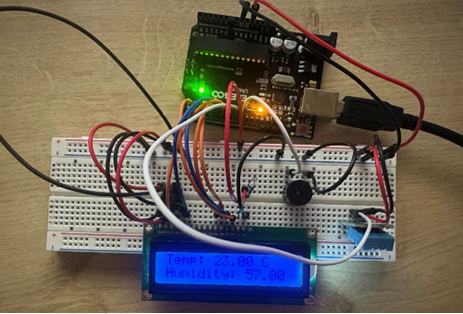
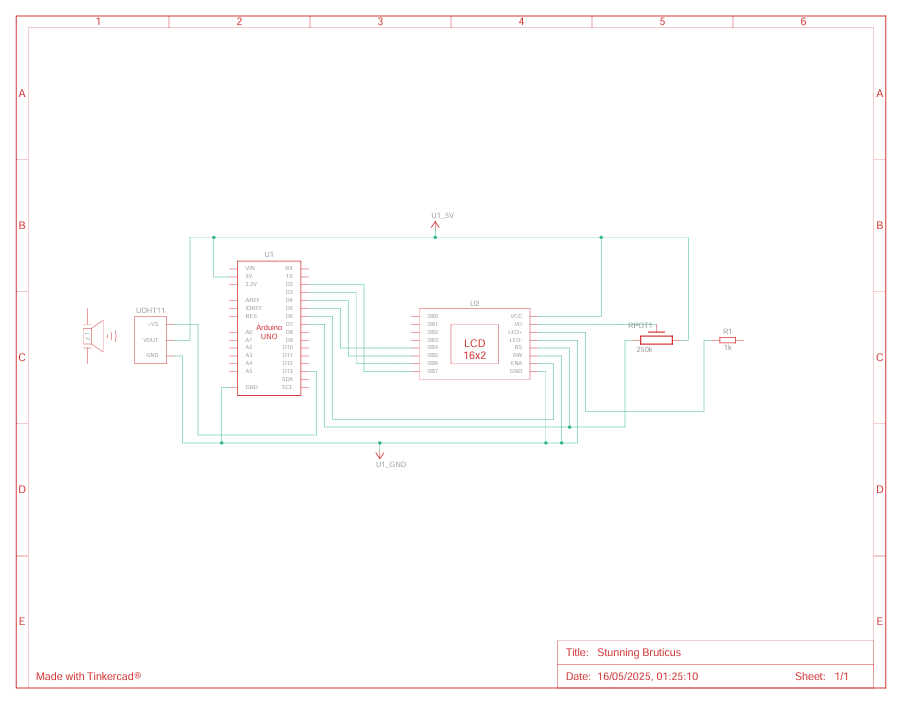
To simulate the circuit, I used Tinker cad, which I’ve found useful. Unfortunately, it doesn’t include the DHT11 sensor in its component library, so I substituted it with a basic temperature sensor and simply renamed it to maintain consistency in the schematic. While not ideal, it allowed me to continue planning and visualising my design.
One of the biggest takeaways this week was realising how much I’m beginning to enjoy circuit building, even though I wouldn’t yet say I’m fluent in it. These last two projects have shown me that with the right guidance and a bit of persistence, even complex-looking tasks can become manageable and enjoyable. I’m looking forward to refining this prototype further and continuing to grow both my technical confidence and creativity.